Project Overview
What you will build
Section titled “What you will build”This walkthrough documents the event-driven-serverless-platform-demo — a consolidated AWS
Amazon Web Services — cloud platform for ingest, processing, storage, API, and portal hosting in this walkthrough. event-driven serverless platform for GNSS
Global Navigation Satellite System — source of RINEX observation data ingested and calibrated in this platform. RINEX
Receiver Independent Exchange Format — standard GNSS observation file format synced from GeoNet and calibrated by the processor. ingest, PyTECGg
PyTECGg — Python library performing TEC calibration on GNSS RINEX observations inside the processor container. TEC
Total Electron Content — integrated electron density along the GNSS signal path; primary calibrated output of the processor. calibration, and interactive visualization.
By the end you will have:
- Ingest — hourly RINEX
Receiver Independent Exchange Format — standard GNSS observation file format synced from GeoNet and calibrated by the processor. synced from GeoNet
GeoNet open data — public S3 bucket `geonet-open-data` with GNSS RINEX hourly files under `gnss/rinexhourly/`. Not owned by this stack; no push notification when new files arrive. into a private data lake
Private S3 bucket holding raw RINEX under `raw/rinexhourly/` and processed TEC output under `processed/tec/`. - Processing — SQS
Amazon Simple Queue Service — buffers ingest and reprocess messages between S3/API and the processor Lambda. -driven processor Lambda
Processor Lambda container — runs PyTECGg calibration per SQS message; adopted when a Batch on Fargate parallel-execution quota increase was rejected. Image from `ghcr.io/platformfuzz/tec-processor-image` mirrored to ECR. container writing calibrated TEC output - Presentation — REST API
Amazon API Gateway — REST API exposing `/catalog`, `/query`, and `/reprocess`. Browser CORS is locked to the Amplify hostname; CLI clients call the API Gateway URL directly. and an Amplify
AWS Amplify — hosts the Vite portal SPA. This walkthrough deploys via manual zip upload (no Git connection required). portal for charts, maps, and reprocess jobs - Operations — CloudWatch
Amazon CloudWatch — alarms, dashboard (`event-driven-platform`), and structured Lambda logs for observability. alarms, SNS
Amazon Simple Notification Service — publishes CloudWatch alarm notifications; subscribe an email endpoint after deploy. notifications, and theevent-driven-platformdashboard
Everything lives in one monorepo and is provisioned through Terraform
HashiCorp Terraform — provisions all platform infrastructure through five modules in `terraform/`. .
Architecture and data flow
Section titled “Architecture and data flow”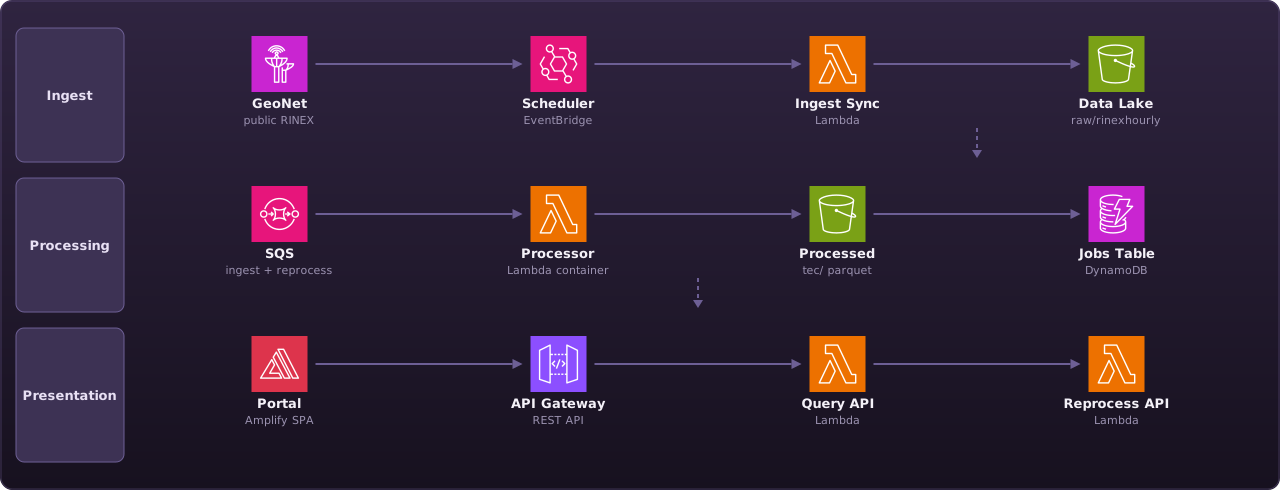
Data moves left to right across three layers — ingest, processing, and presentation. New raw files in S3
Amazon Simple Storage Service — data lake bucket for raw ingest and processed TEC output; S3 events trigger processing. enqueue the process queue
SQS standard queue — receives S3 ObjectCreated notifications for new raw RINEX files; triggers processor Lambda ingest path. ; operator reprocess jobs use a separate reprocess queue
SQS standard queue — buffers reprocessing job messages from the Reprocess API with lower concurrency than ingest. with lower concurrency so scheduled ingest is not starved.
The browser and CLI reach processed data only through API Gateway
Amazon API Gateway — REST API exposing `/catalog`, `/query`, and `/reprocess`. Browser CORS is locked to the Amplify hostname; CLI clients call the API Gateway URL directly. — not S3 or DynamoDB
Amazon DynamoDB — Jobs table tracks reprocessing job status by `job_id` (queued → processing → completed/failed). directly. Infrastructure Layers covers each component; System Overview covers Terraform modules and design decisions.
Three layers
Section titled “Three layers”| Layer | Responsibility | Key components |
|---|---|---|
| Ingest | Sync recent RINEX from GeoNet into the data lake | EventBridge Scheduler Amazon Simple Storage Service — data lake bucket for raw ingest and processed TEC output; S3 events trigger processing. Data_Lake_Bucket Private S3 bucket holding raw RINEX under `raw/rinexhourly/` and processed TEC output under `processed/tec/`. |
| Processing | Calibrate raw observations into TEC output | Process_Queue Amazon DynamoDB — Jobs table tracks reprocessing job status by `job_id` (queued → processing → completed/failed). Jobs table DynamoDB table keyed by `job_id` — stores reprocess job metadata, parameters, status, and output references. |
| Presentation | Query, visualize, and submit reprocessing jobs | API Gateway |
What you will see
Section titled “What you will see”Hosted portal
Section titled “Hosted portal”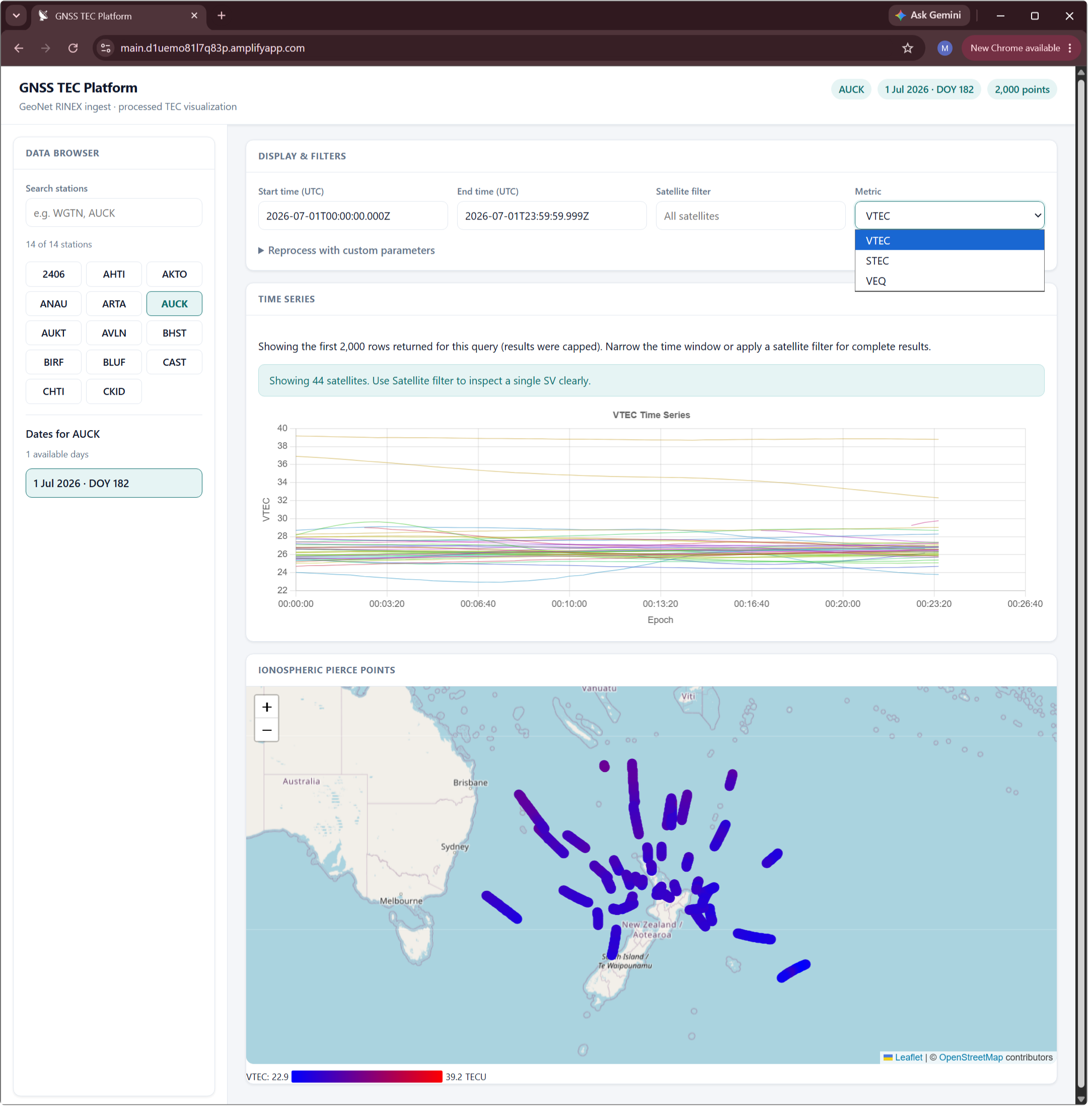
The portal browses processed stations
Four-character GNSS receiver site identifier (e.g. `auck`) parsed from RINEX filenames and used in processed key paths. , charts TEC metrics over time, and maps ionospheric pierce points
Ionospheric Pierce Point — geographic location where the satellite signal intersects the ionospheric shell; plotted on the portal IPP map. . See Portal Usage and Amplify Portal.
Operations dashboard
Section titled “Operations dashboard”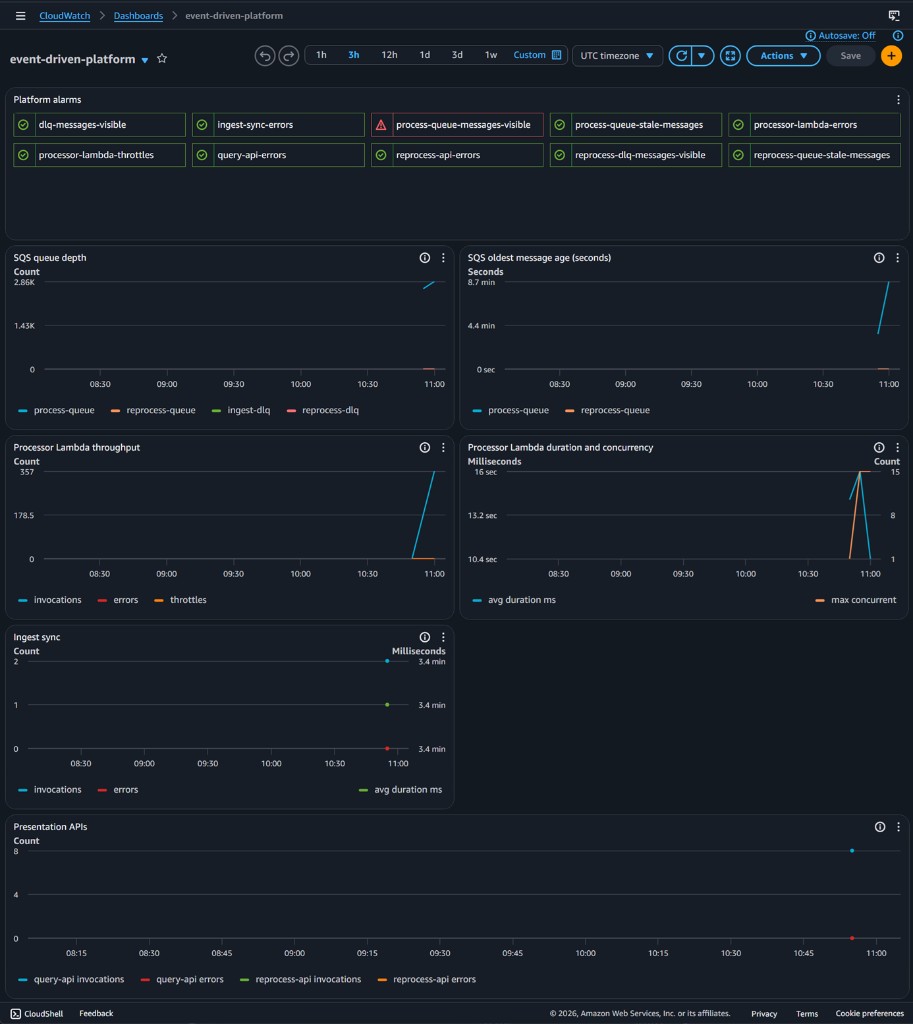
Observability spans all layers. The event-driven-platform dashboard aggregates alarm health, queue backlog, Lambda throughput, and API activity. Subscribe to SNS and verify alarms in Alarms and Dashboard.
Key terms
Section titled “Key terms”| Term | Definition |
|---|---|
| Demo Repo event-driven-serverless-platform-demo — source repository for Terraform, Lambda services, portal, and scripts. Commands run from its root with `terraform -chdir=terraform` unless stated otherwise. | Source repository event-driven-serverless-platform-demo — run commands from its root with
|
| RINEX Receiver Independent Exchange Format — standard GNSS observation file format synced from GeoNet and calibrated by the processor. | GNSS observation files synced from GeoNet and calibrated by the processor |
| TEC Total Electron Content — integrated electron density along the GNSS signal path; primary calibrated output of the processor. | Total Electron Content — primary calibrated output served by the Query API and portal |
| Data Lake Private S3 bucket holding raw RINEX under `raw/rinexhourly/` and processed TEC output under `processed/tec/`. | Private S3 bucket with |
| Process vs reprocess queues SQS standard queue — receives S3 ObjectCreated notifications for new raw RINEX files; triggers processor Lambda ingest path. | Ingest path ( Process_Queue |
| Processor Lambda Processor Lambda container — runs PyTECGg calibration per SQS message; adopted when a Batch on Fargate parallel-execution quota increase was rejected. Image from `ghcr.io/platformfuzz/tec-processor-image` mirrored to ECR. | Container image ( |
| Terraform stack HashiCorp Terraform — provisions all platform infrastructure through five modules in `terraform/`. | Five modules in |
Walkthrough path
Section titled “Walkthrough path”The sidebar follows a deploy → verify → use order.
Before you deploy
Section titled “Before you deploy”- Prerequisites — Tools and Accounts
- Architecture — System Overview and Infrastructure Layers
Deploy
Section titled “Deploy”Provision the stack in order: Terraform Init → ECR and Processor Image → Staged Apply → Amplify Portal → CORS Lockdown.
Verify
Section titled “Verify”Confirm each stage of the pipeline:
- Scheduler and ingest — EventBridge Scheduler, Manual Ingest
- Processing — SQS Queues, Processor Lambda, S3 Processed Output
- Presentation — REST API, Reprocess Workflow, Portal
- Operations — Alarms and Dashboard
Use and reference
Section titled “Use and reference”- Usage — REST API, Portal, Manual Ingest
- Data Contract — SQS, DynamoDB, S3 keys, Parquet, and API schemas
- Development, Troubleshooting, and Reference — local setup, common issues, Terraform outputs
Next steps
Section titled “Next steps”- Confirm Tools and Accounts before cloning the demo repo.
- Read System Overview for module layout and design decisions.
- Follow Terraform Init to deploy the stack.