Ingest Pipeline
The ingest pipeline fetches AWS announcements from public RSS feeds, generates
embeddings
A vector representation of text — a list of floating-point numbers that captures semantic meaning. Generated by an embedding model. using
Titan Embeddings V2
Amazon Titan Embeddings V2 — the Bedrock foundation model used to generate 1024-dimensional text embeddings. , and stores them in
S3 Vectors
Amazon S3 Vectors — a purpose-built vector storage capability within S3 that enables similarity search over embeddings without a separate vector database. for similarity search. Each run processes the full
corpus and upserts vectors — making it safe to re-run at any time.
Trigger sources
Section titled “Trigger sources”The ingest Lambda
AWS Lambda — serverless compute. This project uses two functions: ingest (RSS → embed → store) and query (search → answer). can be invoked three ways:
| Trigger | Source value | When it fires |
|---|---|---|
EventBridge | eventbridge | Daily at 06:00 UTC (configurable via |
| API Gateway endpoint | api | Admin sends |
Bootstrap ( | terraform | Runs once during initial deployment via |
Step-by-step flow
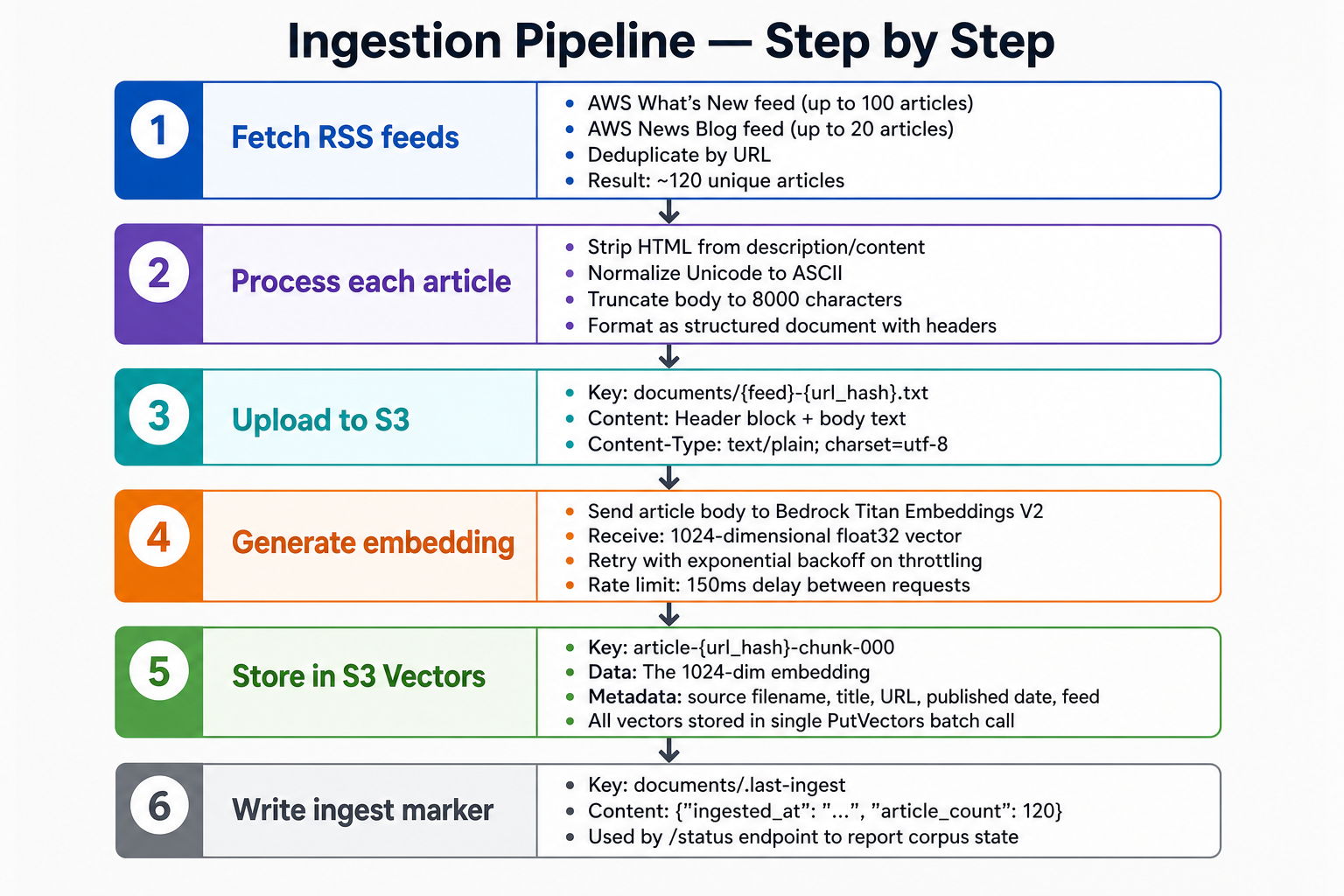
Section titled “Step-by-step flow”The ingest pipeline runs through these stages:
- Fetch RSS feeds — download articles from AWS What’s New and AWS News Blog
- Strip HTML — extract plain text, normalize unicode, deduplicate by URL
- Truncate — limit each article body to 8,000 characters
- Upload to S3 — store each article as a
.txtfile in the source bucket - Embed — generate a 1024-dimensional vector for each article via Bedrock
- PutVectors — store vectors with metadata in S3 Vectors
- Write marker — record
.last-ingestwith timestamp and count
RSS fetching
Section titled “RSS fetching”The fetch_articles() function downloads from two feeds:
FEEDS = ( ("aws-whats-new", "https://aws.amazon.com/about-aws/whats-new/recent/feed/", 100), ("aws-news-blog", "https://aws.amazon.com/blogs/aws/feed/", 20),)Each feed has a per-source limit matching what the public endpoints expose. Articles are deduplicated by URL across feeds and a minimum of 5 articles is required for a successful run.
The HTTP fetch includes retry logic:
def _fetch_bytes(url: str, retries: int = 2) -> bytes: request = Request(url, headers={"User-Agent": USER_AGENT}) last_error: Exception | None = None for attempt in range(retries): try: with urlopen(request, timeout=60) as response: return response.read() except (HTTPError, URLError, TimeoutError) as exc: last_error = exc if attempt + 1 < retries: time.sleep(2) raise RuntimeError(f"Failed to fetch {url}: {last_error}") from last_errorHTML stripping and text preparation
Section titled “HTML stripping and text preparation”Raw RSS content is HTML. The pipeline strips tags, unescapes entities, normalizes unicode to ASCII, and truncates to MAX_BODY_CHARS (8,000):
def _strip_html(value: str) -> str:    if not value:        return ""    unescaped = html.unescape(value)    parser = _HTMLTextExtractor()    parser.feed(unescaped)    parser.close()    text = parser.get_text() or re.sub(r"<[^>]+>", " ", unescaped)    return re.sub(r"\s+", " ", text).strip()
def _truncate_body(text: str) -> str: if len(text) <= MAX_BODY_CHARS: return text trimmed = text[:MAX_BODY_CHARS].rsplit(" ", 1)[0] return trimmed + "\n\n[Truncated for demo embedding size.]\n"Embedding with Bedrock
Section titled “Embedding with Bedrock”Each article body is embedded using Titan Embeddings V2
Amazon Titan Embeddings V2 (amazon.titan-embed-text-v2:0) — converts text into 1024-dimensional vectors for similarity search. via the Bedrock runtime API. The function includes exponential backoff for throttling:
def _bedrock_embed(client, model_id: str, text: str) -> list[float]: last_error = None for attempt in range(6): try: response = client.invoke_model( modelId=model_id, contentType="application/json", accept="application/json", body=json.dumps({"inputText": text}), ) payload = json.loads(response["body"].read()) return payload["embedding"] except ClientError as exc: code = exc.response.get("Error", {}).get("Code", "") if code not in {"ThrottlingException", "ServiceUnavailableException"}: raise last_error = exc time.sleep(min(2**attempt, 30)) raise RuntimeError(f"Bedrock embed throttled after retries: {last_error}")Key details:
- Up to 6 retry attempts with exponential backoff (1s, 2s, 4s, 8s, 16s, 30s max)
- Only retries
ThrottlingExceptionandServiceUnavailableException - All other errors raise immediately
- A 150ms sleep between articles avoids hitting Bedrock rate limits
Storing vectors with PutVectors
Section titled “Storing vectors with PutVectors”After embedding, all vectors are written to S3 Vectors in a single PutVectors
S3 Vectors PutVectors API — stores one or more vectors with associated metadata in a vector index. call:
vectors.append(    {        "key": f"article-{article.url_hash}-chunk-000",        "data": {"float32": embedding},        "metadata": {            "source": article.filename,            "title": article.title,            "url": article.url,            "published": article.published,            "feed": article.feed,            "chunk": "0",        },    })
_put_vectors(s3vectors, config, vectors)
The vector key uses the URL hash, so re-ingesting the same article upserts rather than duplicates.
Vector metadata
Section titled “Vector metadata”Each stored vector carries metadata used during query and scoring:
| Field | Example | Used for |
|---|---|---|
source | aws-whats-new-a1b2c3d4.txt | Loading full document from S3 at query time |
title | Amazon S3 Vectors is now GA | Display in search results and LLM context |
url | https://aws.amazon.com/… | Citation links in generated answers |
published | 2025-06-01T12:00:00Z | Recency scoring (newer articles rank higher) |
feed | aws-whats-new | Source attribution |
chunk | 0 | Always “0” — single-chunk strategy (one vector per article) |
Last-ingest marker
Section titled “Last-ingest marker”After all vectors are stored, the pipeline writes a JSON marker to S3:
marker = { "ingested_at": fetched_at.strftime("%Y-%m-%dT%H:%M:%SZ"), "article_count": len(items),}s3.put_object( Bucket=config.source_bucket, Key=config.last_ingest_key, Body=json.dumps(marker).encode("utf-8"), ContentType="application/json",)This marker is read by the status endpoint to report corpus freshness.
Error handling and retries
Section titled “Error handling and retries”| Failure point | Behavior | Max retries |
|---|---|---|
| RSS feed HTTP errors | Retry with 2s backoff, then raise | 2 |
| Too few articles fetched | Raise | 0 |
| Bedrock throttling | Exponential backoff (1s–30s cap) | 6 |
| Bedrock non-throttle errors | Raise immediately (no retry) | 0 |
| S3/S3 Vectors write failures | Raise (Lambda timeout is 480s) | 0 |
Related pages
Section titled “Related pages”- Embeddings strategy — why single-chunk and Titan V2
- Query pipeline — how stored vectors are searched
- Scoring — how recency metadata affects ranking