Query Pipeline
The query pipeline transforms a user question into a structured, sourced answer. It embeds the question, searches S3 Vectors
Amazon S3 Vectors — a purpose-built vector storage capability within S3 that enables similarity search over embeddings without a separate vector database. for similar documents, reranks results using similarity and recency, builds a context window, and generates a response with Bedrock
Amazon Bedrock — a fully managed service for accessing foundation models (embedding and LLM) via a unified API. .
Request Lifecycle
Section titled “Request Lifecycle”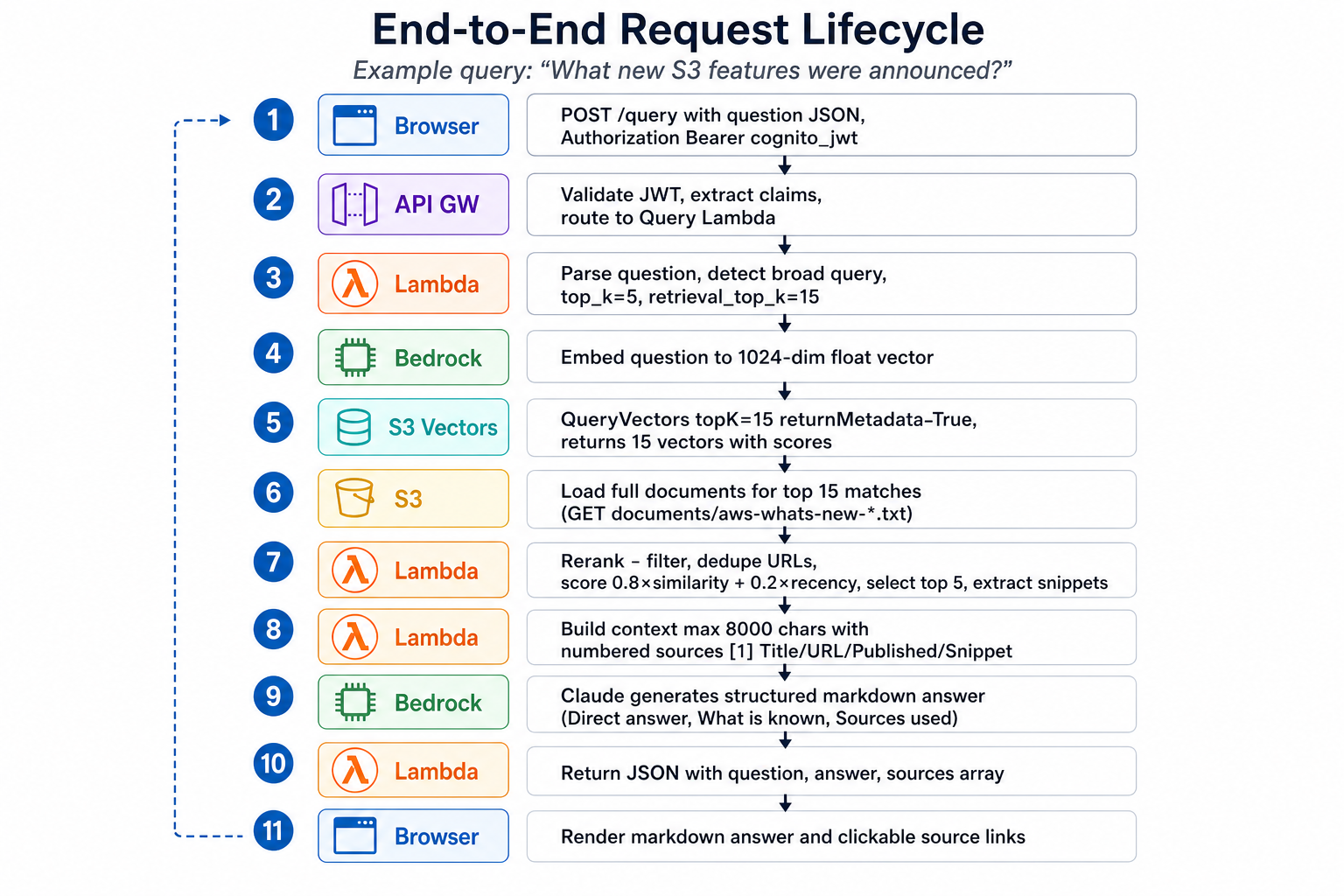
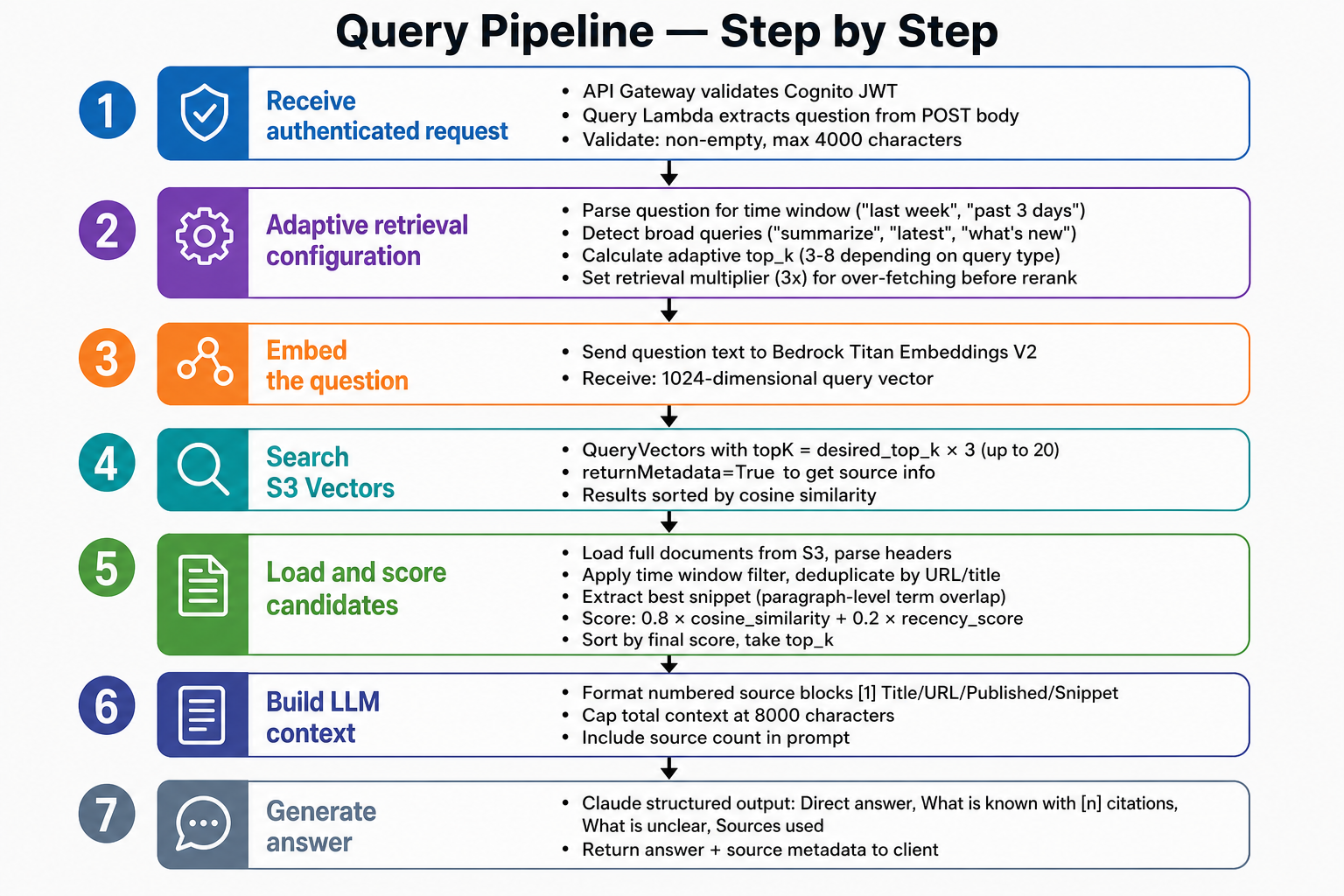
A complete query passes through six stages:
- Embed — Convert the user question into a 1024-dimensional vector using Titan Embeddings V2
Amazon Titan Embeddings V2 — the Bedrock foundation model used to generate 1024-dimensional text embeddings. - Search — QueryVectors
S3 Vectors QueryVectors API — finds the most similar vectors to a query vector using Top-K nearest neighbor search. from S3 Vectors with an over-fetched Top-K - Load — Retrieve full document bodies from S3 for each match
- Rerank — Score candidates by 80% similarity + 20% recency, then select the best
- Context — Assemble top snippets into a prompt context window
- Generate — Invoke Claude via Bedrock to produce a structured answer
Adaptive Top-K Strategy
Section titled “Adaptive Top-K Strategy”Rather than using a fixed Top-K
The number of nearest neighbor results returned by a vector similarity search query. value, the pipeline adapts how many vectors it retrieves based on the question type.
MIN_TOP_K = 3MAX_TOP_K = 8RETRIEVAL_MULTIPLIER = 3
def _adaptive_top_k(question: str, requested_top_k: int) -> int:    target = max(MIN_TOP_K, requested_top_k)    if _extract_time_window_days(question) is not None:        target = max(target, 6)    elif _is_broad_query(question):        target = max(target, 5)    return min(target, MAX_TOP_K)
The function detects two patterns:
- Time-windowed queries (e.g., “last 2 weeks”) — bumps to at least 6 results
- Broad queries (e.g., “summarize recent updates”) — bumps to at least 5 results
Over-Fetch and Filter
Section titled “Over-Fetch and Filter”The pipeline retrieves more vectors than it needs, then narrows down:
desired_top_k = _adaptive_top_k(question, top_k)retrieval_top_k = min(desired_top_k * RETRIEVAL_MULTIPLIER, 20)time_window_days = _extract_time_window_days(question)cutoff = ( datetime.now(timezone.utc) - timedelta(days=time_window_days) if time_window_days else None)After retrieval, candidates are filtered:
- Source validation — skip vectors with no source metadata
- Time window — discard documents published before the cutoff date
- Deduplication — remove duplicates by normalized URL or title
Reranking
Section titled “Reranking”Each surviving candidate receives a composite score combining cosine similarity
Cosine similarity — a distance metric that measures the angle between two vectors. Values range from 0 (opposite) to 1 (identical direction). Preferred for text embeddings. with a recency boost:
RECENCY_HALF_LIFE_DAYS = 30.0
def _recency_score(published_dt: datetime | None) -> float:    if published_dt is None:        return 0.25    age_days = max(        (datetime.now(timezone.utc) - published_dt).total_seconds() / 86_400.0,        0.0,    )    return math.exp(-age_days / RECENCY_HALF_LIFE_DAYS)
The final score formula:
final_score = (0.8 × similarity) + (0.2 × recency_score)Candidates are sorted by final score descending, then the top desired_top_k are selected.
Snippet Extraction
Section titled “Snippet Extraction”For each candidate, the pipeline extracts the most relevant paragraphs to use as context:
def _best_snippet(body: str, question: str, max_chars: int = 700) -> str: paragraphs = [ part.strip() for part in body.split("\n\n") if part.strip() ] question_terms = _tokenize(question) scored = [] for paragraph in paragraphs: terms = _tokenize(paragraph) overlap = len(question_terms.intersection(terms)) scored.append((overlap, len(paragraph), paragraph)) scored.sort(key=lambda row: (row[0], row[1]), reverse=True) # Select paragraphs with highest term overlap ...Paragraphs are ranked by term overlap with the question. The function greedily selects paragraphs until the 700-character budget is consumed, prioritizing those with the most keyword matches.
Context Window Building
Section titled “Context Window Building”The selected candidates are assembled into a structured context block for the LLM
Large Language Model — Anthropic Claude accessed via Bedrock inference profile. Generates structured answers from retrieved context. :
MAX_CONTEXT_CHARS = 8_000
def _build_context(candidates, max_chars=MAX_CONTEXT_CHARS):    blocks = []    total = 0    for idx, candidate in enumerate(candidates, start=1):        block = (            f"[{idx}] Title: {candidate.source.title}\n"            f"[{idx}] URL: {candidate.source.url}\n"            f"[{idx}] Published: {candidate.source.published}\n"            f"[{idx}] Feed: {candidate.source.feed}\n"            f"[{idx}] Snippet:\n{candidate.snippet}\n"        )        if total + len(block) > max_chars:            break        blocks.append(block)        total += len(block)    return "\n---\n".join(blocks)
Each source is numbered [1], [2], etc., so the LLM can cite them in its response. The context is capped at 8,000 characters to stay within prompt budget.
LLM Generation
Section titled “LLM Generation”The final stage invokes Claude via Bedrock inference profile
A Bedrock cross-region inference profile that routes requests to the nearest available region. Used for the LLM (au.anthropic.claude-sonnet-4-5-20250929-v1:0). with a structured prompt:
def _bedrock_llm(client, model_id, context, question, source_count): body = { "anthropic_version": "bedrock-2023-05-31", "max_tokens": 1024, "messages": [{ "role": "user", "content": ( "You are an AWS news briefing assistant. " "Use only the provided context.\n" "If the context is insufficient, state that " "clearly and do not guess.\n\n" "Output markdown using this structure:\n" "## Direct answer\n## What is known\n" "## What is unclear\n## Sources used\n\n" f"There are {source_count} sources in context. " "Every factual bullet must cite at least one " f"source.\n\nContext:\n{context}\n\n" f"Question: {question}" ), }], } response = client.invoke_model( modelId=model_id, body=json.dumps(body), ... )The prompt enforces:
- Grounding — use only the provided context, no guessing
- Structure — direct answer, known facts with citations, unclear items, sources used
- Citation — every factual bullet must reference at least one numbered source
Entry Point
Section titled “Entry Point”The ask() function orchestrates the entire pipeline:
def ask(config: Config, question: str, top_k: int = 3) -> QueryResult:    """Run the full RAG query pipeline."""    bedrock = boto3.client("bedrock-runtime", region_name=config.aws_region)    s3vectors = boto3.client("s3vectors", region_name=config.aws_region)
    desired_top_k = _adaptive_top_k(question, top_k)    retrieval_top_k = min(desired_top_k * RETRIEVAL_MULTIPLIER, 20)
query_embedding = _bedrock_embed(bedrock, config.embedding_model_id, question) response = s3vectors.query_vectors( vectorBucketName=config.vector_bucket, indexName=config.vector_index, queryVector={"float32": query_embedding}, topK=retrieval_top_k, returnMetadata=True, ) # ... filter, rerank, build context, generate ... return QueryResult(question=question, answer=answer, sources=sources)Pipeline Parameters
Section titled “Pipeline Parameters”| Parameter | Value | Purpose |
|---|---|---|
MIN_TOP_K | 3 | Minimum number of sources in final answer |
MAX_TOP_K | 8 | Maximum sources regardless of query type |
RETRIEVAL_MULTIPLIER | 3 | Over-fetch factor (retrieve 3× desired) |
MAX_CONTEXT_CHARS | 8,000 | Maximum context window size for LLM prompt |
RECENCY_HALF_LIFE_DAYS | 30 | Exponential decay half-life for recency scoring |
| Snippet max chars | 700 | Character budget per document snippet |
max_tokens | 1,024 | Maximum LLM response length |
Related Pages
Section titled “Related Pages”- Similarity Scoring — detailed breakdown of the scoring formula
- Embeddings — how text becomes vectors
- Ingest Pipeline — how documents enter the system